Showing posts with label Tariff. Show all posts

Sunday, February 24, 2019

USA & China Trade War: March 1 Deadline Approaches

In addition to my kitchen renovation, with bated breath we are all awaiting  the results of meetings on the US trade war with China. I get an update on the situation thru snippets of news and the daily stock market levels. I am praying for God's help in this situation.  To me, it's all about fairness on either side. However, China is a fierce force to be reckoned with. May President Trump never forget  - RRE

U.S. President Donald Trump’s threat to more than double American tariffs on Chinese goods if an agreement isn’t reached by March 1 would escalate a bruising trade war that’s shaken the world economy and caused companies to reconfigure their supply chains. - Bloomberg.com


1. What’s so important about March 1?

That’s the end of a 90-day truce that Trump and China’s Xi Jinping agreed toin December. The U.S. agreed then to delay a planned increase, to 25 percent from 10 percent, in tariffs on almost half the goods the U.S. buys from China, worth some $200 billion. American and Chinese officials have been negotiating since then. With Trump and Xi both reporting progress, Trump is said to be considering pushing back the deadline by 60 days.

2. How else might this escalate?

If Trump goes forward with the higher 25 percent tariffs, China could reply with countermeasures, and that could prompt Trump to follow through on threats to slap duties on a further $267 billion of goods.
 Photographer: Qilai Shen/Bloomberg

3. What’s the risk for the U.S.?

American shoppers have been mostly insulated from the trade war, since inflation remains tame and the tariffs haven’t hit staples like clothing, footwear and toys. That could change. A January report by Bank of AmericaCorp. analysts said any escalation of the trade war “would be much more painful” for the U.S., triggering renewed market volatility and undermining investor confidence.

4. What’s the risk for China?

An escalation would deepen the slowdown in economic growth and raise pressure on the government to respond with higher public spending. That would likely be funded by debt, undermining the government’s quest to reduce the country’s heavy debt burden. Bloomberg Economics estimates China would avoid a 0.3 percent drag on 2019 gross domestic product if the trade truce holds. Their base case -- assuming an escalation is avoided -- is for economic growth in China to slow to 6.2 percent in 2019, down from 6.6 percent in 2018.


5. What are the sticking points to a deal?

Enforcement, intellectual-property protection and technology. Trump has pledged that any deal will contain “strong enforcement language,’’ yet his aides are still figuring out what that should be -- and how to get China to sign off. The World Trade Organization is one possible arena for policing a deal, but the U.S. administration has shown little patience for it. It’s tough to see what the Chinese side will agree to beyond promises to buy more U.S. goods, given their denials regarding forced technology transfers or other alleged misbehavior. (The widening U.S. government crackdown on Huawei Technologies Co., a Chinese telecommunications giant, underscores the challenge.) The two sides were said to remain far apart on structural reforms to China’s economy that the U.S. has requested.

6. Why are we in a trade war?


Trump routinely points to the large U.S. trade deficit, the difference between imports and exports, as a symbol of a declining manufacturing base and the loss of American might. He aims to reduce the goods-and-services gap with China, which totaled $566 billion in 2017, by both browbeating and enticing U.S. companies to import less and export more. In addition to goods from China he’s imposed tariffs (which act like a tax on imports) on steel and aluminum from countries including allies Canada, Mexico and the European Union.

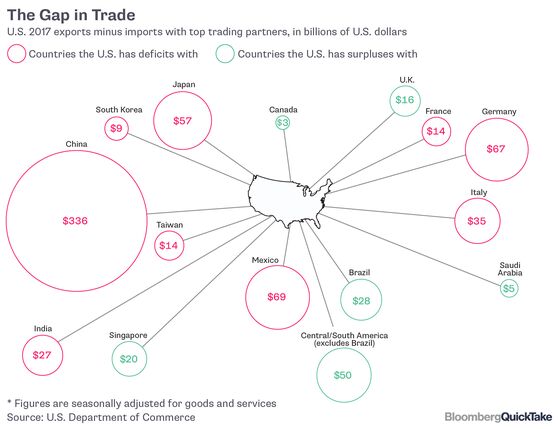


GRAPHIC: The Gap in Trade

7. Will Trump’s strategy work?

It depends on who blinks first. China has agreed in principle to increase imports of U.S. agricultural products, along with energy, industrial products and services as part of a path to eliminate its U.S. trade imbalance. That promise might form the basis of a preliminary agreement, though the tariffs may stay in place while the two sides work out differences in tougher issues such as the heavy involvement of the state in China’s economy. Trump’s threat to abandon the North American Free Trade Agreement prompted Canada and Mexico, the two other signatories of that treaty, to agree to revisions. Tariffs on metals and threatened duties on cars had the EU and Japan also looking to deal.

8. What’s been the impact so far?

Investors and executives routinely cite the trade war between the world’s two biggest economies as one of the biggest threats to all kinds of businesses. The International Monetary Fund, cutting its forecast for the world economy for the second time in three months due in part to trade tensions, said in January that global growth would be 3.5 percent in 2019. Meanwhile the U.S. trade deficit widened in 2018, partly because the stronger dollar made U.S. exports pricier.

9. What are companies saying?

It depends on what you sell. Apple, Starbucks, Volkswagen and FedEx are among those to have cited a slowing Chinese economy in their outlooks. More than 400 publicly traded Chinese companies warned on their earnings. While the trade war is only one factor that’s weighing on demand -- weakness in Europe and the impact of fading U.S. fiscal stimulus are others -- it’s probably the issue that most concerns executives. Some are even looking at uprooting their supply chain. Some businesses in Southeast Asia expect China’s pain to be their exporting gain. Metals tariffs have helped producers with American plants, such as ArcelorMittalU.S. Steel and Nucor. They’re charging higher prices, and some have reopened shuttered sites. But some U.S. business groups say the tariffs and retaliatory duties have hurt American industry, farmers and workers.
- by  B L O O M B E R G


Kiss the Son, lest he be angry, 
and ye perish from the way,
 when his wrath is kindled but a little.
 Blessed are all they 
that put their trust in him.

(Psalm 2:12)


**

Sunday, July 1, 2018

US Trade War with Cheater China

The first I ever personally heard of China's blatant "espionage" was hubby mentioning that during a group tour at his Chicago-based company, the Chinese Reps took pictures of his manufacturing company's products and machinery and who knows what else.  Not just for the sake of souvenirs, that is certain.   Why this stupidity was allowed and for what purpose is left to one's own worst economic imagination. -- RRE
Photo: Angela Major/The Janesville Gazette via AP

The US has to stand up to China's abusive trade practices like intellectual property theft. And we won't leave farmers to face Chinese bullying alone.

- Sonny Perdue


In 2011, a group of Chinese nationals dug up genetically engineered seeds from an Iowa corn field and planned to steal and send them back to China, so they could be reverse engineered. Those seeds, the result of years of research and millions of dollars of American investment, now stand as one of countless pieces of evidence in the case against China for intellectual property theft and unfair trade practices.
Now, President Donald Trump is standing up to China, which wrongly believes it can bully our farmers to get America to back away from defending our national interests. The president understands that our farmers feed, fuel and clothe this nation and the world, and he will not allow U.S. agriculture to bear the brunt of China’s retaliatory tactics.
American producers have benefited from the policies of the Trump administration, including historic tax reforms and reduced regulations. And farmers know that 20 cents of every dollar of their income relies on trade, which is why they are watching the situation with China closely. The simple truth is that when trading partners break the rules, there must be consequences. 

Pressuring China

To stop China’s predatory attacks on America’s innovation base, President Trump is instituting a program of tariffs and is considering investment restrictions and strengthened export controls. These tariffs will help pressure the Chinese to stop engaging in unfair practices and fully open up its markets to U.S. products, including U.S. technologies. The correct response from China would be to stop stealing from Americans and give American products a level playing field to compete in China, not to retaliate and reinforce its own position. 

There is no denying that the disruption in trade relations with China is unsettling to many in agriculture, but if the president succeeds in changing China’s behavior, America’s farmers will reap the benefits. 
In the meantime, the president has instructed me to craft a strategy to support our farmers in the face of retaliatory tariffs. At the U.S. Department of Agriculture, we have tools at our disposal to support farmers faced with losses that might occur due to downturns in commodities markets. To this point, we have not unveiled our strategy, as it is not good practice to open our playbook while the opposing team is watching. 
But farmers should know this: They have stood with President Trump and his policies, and we will make good on our promise to stand with them as well. If China does not soon mend its ways, we will quickly begin fulfilling our promise to support producers, who have become casualties of these disputes.
Without question, there is much at stake for this nation in trade disagreements. A bullying and predatory China has made no secret of the fact that it seeks to acquire America’s technological crown jewels by any means necessary — through physical and cybertheft, forced technology transfer, evasion of our export controls, and state-directed and -funded investment in sensitive technology. And while it may seem outrageous, China has rejected American genetically engineered products, while sending agents crawling in corn fields to pilfer samples of our technology and even purchasing a company that provides U.S. farmers with key genetically engineered.

Economic future

President Trump has said correctly that if China captures the industries of tomorrow, America will not have an economic future to look forward to — and our national security will be severely compromised. Cutting-edge technologies — from artificial intelligence, autonomous vehicles and biotechnology to aerospace, high-tech shipping and robotics — are critical to our defense. We are faced with a decision: Will others determine our destiny, or will we control our own future?
China began raiding our economy long before a team of thieves infiltrated that Iowa corn field, but President Trump aims to stop the larceny now. The president is a tough negotiator, and I am confident that American agriculture will flourish because of trade relationships that are smarter, stronger and better than before. China might underestimate the strength and resolve of American farmers, but the president does not. And he will not allow our agricultural producers to suffer because of China’s continued bad actions.
by Sonny Perdue,
U.S. secretary of agriculture.
 Follow him on Twitter: @SecretarySonny

read USA Today article H E R E


Trump Will Protect US Farmers

George Ervin "Sonny" Perdue III

video: Game of whac-a-Mole??


8.8.17.18

Tuesday, June 12, 2018

LIST: Canada Will Impose Tariffs / Taxes on These US Goods in July (chocolate, coffee, whiskey, pizza, soy sauce, candles, jam, etc)

On March 1, 2018, President Donald Trump announced his intention to impose a 25% tariff (tax) on steel and a 10% tariff (tax) on aluminum imports.  

Those tariffs finally came to pass for Canada, Mexico, and the EU (European Union) on May 31, 2018.  Take a look at part of the reasons why the USA did so below.  President Trump mentioned Dairy's stiff tariff by Canada in particular:


OTTAWA — Canada will impose retaliatory tariffs on up to $16.6 billion worth of U.S. imports in response to the American decision to place similar levies on Canadian-made steel and aluminum.

The Canadian tariffs, which go into effect July 1, cover a broad range of items. Some, mainly unfinished iron and steel products, will be hit with a 25 per cent tariff, while others, including many consumer products, will be tagged with a 10-per-cent duty.
Here is a list of some of the affected products, which run from industrial metal bars to gherkins, whiskey and felt-tipped pens.

- Iron and non-alloy steel in ingots or other primary forms, including semi-finished products, flat-rolled products, bars and rods and wire.
- Stainless steel ingots or other primary forms, including semi-finished products, flat-rolled products of stainless steel, bars and rods, angles, shapes and sections, and wire.
pc: CHRIS WATTIE / REUTERS
- Other alloy steel in ingots or other primary forms, including semi-finished products, flat-rolled products, bars and rods, angles, shapes and sections, hollow drill bars and rods, wire
- Tubes and pipes, sheet piling, railway or tramway track construction material, pipe for oil or gas pipelines, casing or tubing used in drilling for oil or gas.


- Food products, including yogurt, roasted coffee that is not decaffeinated, prepared meals of fowl or beef.
- Sweets, including maple sugar and syrup, licorice candy, toffee, other sugar confectionery, including white chocolate, not containing cocoa, other chocolate in blocks — slabs or bar, filled or not filled.

- Other foods, including pizza and quiche, cucumbers and gherkins, jams, jellies, strawberry jam, nut purees and pastes, berry purees, and other fruit purees other than banana puree.
- Condiments, including soy sauce, tomato ketchup and other tomato sauces, prepared mustard, mayonnaise, salad dressing, mixed condiments and mixed seasonings, other sauces.
- Soups and broths, mineral waters and aerated waters, containing added sugar or other sweetening matter or flavour.
- Whiskey
- Personal grooming products, including manicure or pedicure preparations, hair spray, shaving and after-shave preparations, soaps and other skin washing products.
both: Playing Cards AND Greeting Card

- Household products, including room deodorizers, automatic dishwasher detergents, candles and tapers, other than those for birthdays, Christmas or other festive occasions; glues or adhesives sold in containers of under a kilogram, tableware and kitchenware, plastic household articles and hygienic or toilet articles, of plastic, toilet paper, handkerchiefs, cleansing or facial tissues and towels, tablecloths and serviettes, printed or illustrated postcards or greeting cards.
- Hardware products, including insecticides and fungicides in packages under 1.36 kg each, plywood (other than bamboo), veneered panels and similar laminated wood.
- Other steel or iron products, including beer kegs, or parts for stoves, ranges, grates, cookers and barbecues.

- Aluminum bars, rods, wire, sheets, foil, tubes and pipes and pipe fittings, most aluminum structural pieces, aluminum reservoirs, tanks, vats and similar containers, including tanks for compressed or liquefied gas.
- Aluminum kitchenware, including tables, scouring pads.
- Appliances, including refrigerator-freezers fitted with separate external doors, instantaneous or storage water heaters, washing machines.
Markers will also be subject to tariff 

- Miscellaneous items, including lawn mowers, electrical boards, panels, consoles, inflatable boats, sailboats, motorboats, mattresses, sleeping bags and other bedding, playing cards, ball point pens, felt tipped and other porous-tipped pens and markers.

Read Full article H E R E


Canada's Retaliatory Tariffs

US Tariffs on Steel and Aluminum

Mr Trump & Tariffs


36.6.20.18
*************